
Your cooker hood should always be at least the same width as your hob — ideally wider. That is the single most important size rule for any London kitchen. Get this wrong and your hood will miss fumes at the edges, leave grease on your cabinets and underperform regardless of how powerful it is.
This guide covers every cooker hood size decision you need to make — for chimney hoods, visor hoods and built-in integrated hoods — across all hob types and London kitchen layouts. By the end, you will know exactly what size hood you need, how to measure correctly, and what to expect from a professional installation.
The Core Rule — Your Cooker Hood Should Match or Exceed Your Hob Width
The golden rule of cooker hood sizing is simple: your hood must be at least as wide as your hob, and ideally 10cm to 20cm wider on each side.
This matters because cooking fumes, steam and grease do not rise straight up in a neat column — they spread outward as they rise. A hood that is the same width as the hob captures the fumes at the edges. A hood that is wider than the hob captures them even more effectively before they reach your cabinets, walls and ceiling.
Here is how this plays out in practice across London kitchens:
| Hob width | Minimum hood width | Recommended hood width |
|---|---|---|
| 50cm hob | 50cm hood | 60cm hood |
| 60cm hob | 60cm hood | 60cm or 70cm hood |
| 70cm hob | 70cm hood | 90cm hood |
| 90cm hob | 90cm hood | 90cm or 100cm hood |
| 100cm+ hob | 100cm hood | 100cm or wider hood |
In London kitchens — particularly the Victorian terraces in Hackney, Islington and Brixton that have been converted into flats — the most common setup is a 60cm hob with a 60cm hood. This combination works well provided the hood is mounted at the correct height above the hob.
Standard Cooker Hood Sizes in the UK
The standard cooker hood sizes available in the UK are 50cm, 60cm, 70cm, 80cm and 90cm, with some premium and range cooker hoods available at 100cm and above.
The two most common sizes sold and installed in London are:
- 60cm — the standard size for most London kitchens. Matches the standard 60cm four-burner hob found in the vast majority of London properties.
- 90cm — used for range cookers and larger hobs. Common in family homes in Dulwich, Wandsworth, Wimbledon and other South and South West London areas where larger kitchen fits are more common.
The 50cm size is less common but used in compact London kitchens — particularly purpose-built flats in Tower Hamlets, Newham and similar areas where worktop space is limited and a smaller four-burner or two-burner hob has been fitted.
Cooker Hood Sizes by Hood Type
What Size Visor Hood Do I Need?
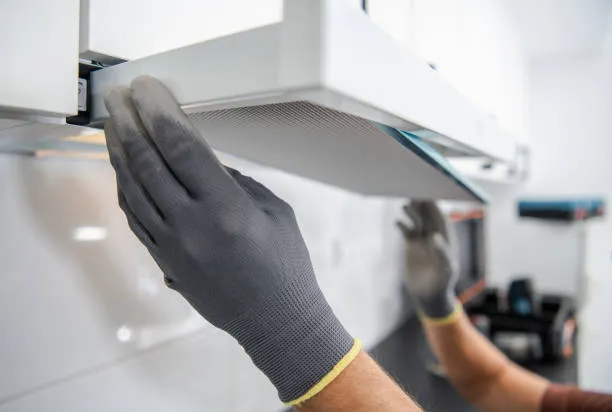
A visor hood (pull-out hood) fits underneath an existing wall cabinet above the hob. The size rule is straightforward: the visor hood must match the width of the wall cabinet it fits into, which should in turn be at least as wide as the hob below.
Visor hoods are available in 50cm, 60cm and 90cm widths. The 60cm visor hood is by far the most commonly installed in London, fitting the standard 60cm cabinet found above most London kitchen hobs.
Visor hood size guide:
- 50cm visor hood — for 50cm hobs in compact London kitchens. Requires a 50cm or wider wall cabinet above the hob.
- 60cm visor hood — for 60cm hobs. The standard choice for most London flats and terraced houses.
- 90cm visor hood — for 90cm hobs or range cookers. Requires a 90cm wall cabinet directly above the hob, which is less common but found in larger London kitchen renovations.
One important point specific to London flats: measure your wall cabinet width before buying a visor hood. Many London kitchen cabinets are not exactly 60cm — older fitted kitchens sometimes have 55cm or 57cm cabinets due to non-standard fitting. A visor hood must fit the cabinet properly to function correctly and look neat.
What Size Chimney Hood Do I Need?
A chimney hood is wall-mounted with no cabinet required above the hob. The sizing rule is the same as the core rule: at least the same width as your hob, ideally 10cm to 20cm wider.
Chimney hoods are available in 50cm, 60cm, 70cm, 80cm, 90cm and 100cm widths. The most common chimney hood installations in London are:
- 60cm chimney hood — the standard for most London houses and ground floor flats with a 60cm hob
- 90cm chimney hood — for range cookers and larger hobs. Very popular in family homes in Dulwich, East Dulwich, Putney and similar areas undergoing kitchen renovations
Chimney hood sizing also involves height, not just width. The chimney column must reach from the top of the hood unit to the ceiling. Most chimney hoods come with adjustable chimney sections that extend to cover ceiling heights between 2.2m and 3m. Always check the manufacturer’s maximum ceiling height specification before purchasing a chimney hood for a London property — Victorian terraces often have ceiling heights of 2.7m to 3.0m, which some budget chimney hood columns cannot reach.
What Size Built-in Hood Do I Need?
A built-in integrated hood is concealed inside a wall cabinet. Sizing for built-in hoods involves two measurements:
- The hood unit width — must match or be slightly smaller than the internal width of the wall cabinet housing it
- The cabinet internal depth — must be sufficient to accommodate the hood motor and body (typically 280mm to 350mm internal depth required)
Built-in hoods are available in 50cm, 60cm and 90cm widths. The 60cm built-in hood is the most commonly installed in London — particularly in premium kitchen renovations in Chelsea, Kensington, Fulham and Islington where a completely clean, minimal kitchen aesthetic is the priority.
Always check the internal cabinet dimensions before purchasing a built-in hood. Many standard wall cabinets in London kitchens are not deep enough internally to accommodate a built-in hood motor without modification. Our engineers assess this at booking.
How to Measure for a Cooker Hood in London — Step by Step
Getting the measurements right before booking cooker hood installation in London saves time and avoids the cost of returning a wrongly-sized hood.
Step 1 — Measure your hob width
Measure the full external width of your hob in centimetres from edge to edge. This is your minimum hood width. A 60cm hob needs at minimum a 60cm hood.
Step 2 — Measure the available wall width
Measure the width of clear wall space above your hob. In some London kitchens, particularly galley kitchens and smaller terrace conversions, the wall space above the hob is limited by a doorframe, window or adjacent cabinet. Your hood cannot be wider than the available wall space.
Step 3 — Measure the cabinet above the hob (for visor or built-in hoods)
If you are installing a visor or built-in hood, measure:
- External cabinet width — to confirm the hood will fit between adjoining cabinets
- Internal cabinet width — the space inside the cabinet where the hood sits
- Internal cabinet depth — must be at least 280mm for most built-in hood motors
Step 4 — Measure the mounting height
Measure the vertical distance from your hob surface to the underside of the wall cabinet (for visor hoods) or to the intended mounting point on the wall (for chimney hoods).
The correct installation height for a cooker hood above a gas hob is 65cm to 75cm. Above an electric or induction hob, 45cm to 65cm is acceptable. This measurement tells you whether there is enough space for the hood model you have selected.
Step 5 — Measure the ceiling height (for chimney hoods only)
Measure from the floor to the ceiling. Then subtract the height of the chimney hood base unit (typically 50cm to 60cm) and the mounting height above the hob. The chimney column must bridge the remaining gap to the ceiling. Check that the chimney column sections of your chosen hood model can extend to cover this distance.
Should a Cooker Hood Be Wider Than the Hob?
Yes — wider is always better for extraction performance, but it is not always necessary or practical in London kitchens.
A wider hood captures fumes before they spread outward, which means less grease on nearby surfaces and better overall kitchen air quality. The ideal is for the hood to overhang the hob by 5cm to 10cm on each side.
However, in many London kitchens — particularly in compact flats in Hackney, Tower Hamlets, Newham and similar inner-city areas — there is simply no room for a wider hood. The hob sits between two wall cabinets with no space for overhang. In these cases, a same-width hood is absolutely fine and functions well provided it is mounted at the correct height.
Can a Cooker Hood Be Smaller Than the Hob?
Technically yes, but it should be avoided where possible. A hood that is narrower than the hob will miss fumes at the outer burners, leaving grease, moisture and odours to settle on your ceiling and walls.
In practice, a 60cm hood on a 60cm hob is the absolute minimum for effective extraction. Going smaller — for example, fitting a 50cm hood on a 60cm hob — is not recommended and will result in noticeably poor extraction performance, particularly when using the outer burners on the hob.
Cooker Hood Sizing for London Property Types
London properties vary significantly in kitchen size and layout. Here is how cooker hood sizing typically plays out across different property types:
Victorian and Edwardian terraced houses (N, E, SE, SW London)
The most common London property type. Usually has a standard 60cm hob. A 60cm chimney hood or 60cm visor hood is the correct size. High ceilings (2.7m to 3m) mean chimney column length must be checked.
Purpose-built flats (E1, E3, E6, SE postcodes)
Often have compact kitchens with a 50cm or 60cm hob. A 50cm or 60cm visor hood is the most practical choice — compact, fits under the existing cabinet and requires no wall drilling.
New-build apartments (across all London boroughs)
Usually fitted with a 60cm hob. May already have a built-in integrated hood. Replacement must match the original cabinet dimensions exactly — measure internal cabinet depth carefully.
Large family homes (SW, SE, W London)
Frequently have a 90cm range cooker or a 90cm five or six-burner hob. A 90cm chimney hood or 90cm built-in hood is required. Core drilling through an external wall for ducted extraction is common and recommended for range cooker installations.
Listed buildings and conservation areas (Chelsea, Kensington, Camden, Islington)
All hood types can be installed. Ducted installation requiring core drilling through external walls may need listed building consent — always check with your local London borough planning department before drilling.
Extraction Rate — How Powerful Does My Hood Need to Be?
Hood size and extraction power are separate but related. The correct extraction rate for your London kitchen is calculated as:
Kitchen volume (m³) × 10 = minimum extraction rate in m³/hour
For example, a typical London kitchen measuring 3m × 3m × 2.5m ceiling height has a volume of 22.5m³. Multiply by 10 = a minimum extraction rate of 225m³/hour.
Most standard 60cm hoods sold in London provide 350m³/h to 650m³/h, which exceeds the minimum for average-sized London kitchens. For range cookers and larger hobs, look for a minimum of 700m³/h to 900m³/h.
Cooker Hood Size — Common Mistakes in London Kitchens
These are the sizing mistakes our engineers see most often during London cooker hood installations:
- Buying a visor hood before measuring the wall cabinet — the hood does not fit inside the cabinet, or the cabinet is narrower than expected
- Choosing a chimney hood with a short chimney column — the column does not reach the ceiling in a Victorian terrace with 2.8m ceilings
- Fitting a 50cm hood on a 60cm hob — outer burner fumes escape the extraction zone entirely
- Ignoring the internal cabinet depth for built-in hoods — the motor body physically does not fit inside the cabinet
- Mounting the hood too high above the hob — extraction efficiency drops significantly above 75cm on gas hobs
Cooker Hood Size Guide — Quick Reference
| Kitchen type | Hob size | Recommended hood | Best hood type |
|---|---|---|---|
| London flat | 50cm | 50cm–60cm | Visor hood |
| London flat | 60cm | 60cm | Visor hood |
| London terrace | 60cm | 60cm | Chimney hood |
| London terrace | 90cm | 90cm | Chimney hood |
| Premium kitchen | 60cm | 60cm | Built-in hood |
| Premium kitchen | 90cm | 90cm | Built-in hood |
| Range cooker | 90cm–100cm | 90cm–100cm | Chimney hood |
Frequently Asked Questions
What size cooker hood do I need for a 60cm hob?
You need a minimum 60cm cooker hood for a 60cm hob. A 60cm hood is the correct match — it covers the full hob width and captures fumes across all four burners. If your wall space allows, a 70cm hood gives marginally better capture at the edges, but 60cm is the standard and works well in the vast majority of London kitchens.
What size extractor hood do I need for a 90cm hob?
You need a 90cm cooker hood for a 90cm hob. Never fit a 60cm hood on a 90cm hob — the outer burners will be completely outside the extraction zone. A 90cm chimney hood is the most commonly installed solution for 90cm hobs and range cookers in London.
Should a cooker hood be wider than the hob?
Yes, wider is better — but not always necessary. The ideal is for the hood to overhang the hob by 5cm to 10cm on each side. However, in many London kitchens where space is limited, a same-width hood is perfectly functional provided it is mounted at the correct height (65cm to 75cm above a gas hob).
Can a cooker hood be smaller than the hob?
It can fit, but extraction performance will be noticeably poor. Fumes from the outer burners will bypass the hood entirely. A hood should always be at minimum the same width as the hob — never smaller. This applies to all hood types installed in London.
What is the standard cooker hood size in the UK?
The standard cooker hood size in the UK is 60cm. This matches the standard 60cm four-burner hob found in the majority of UK and London kitchens. 90cm is the second most common size, used with range cookers and larger hob formats.
What size visor hood do I need?
Measure your wall cabinet width first — the visor hood must fit inside the cabinet. Then confirm the cabinet is at least as wide as your hob. For most London kitchens, a 60cm visor hood is correct. For compact 50cm hob kitchens, a 50cm visor hood. For range cooker setups with a 90cm wall cabinet, a 90cm visor hood.
How do I measure for a cooker hood?
Measure your hob width (external edge to edge). This is your minimum hood width. For visor hoods, also measure the internal width and depth of the wall cabinet above the hob. For chimney hoods, measure the ceiling height. For all hood types, measure the vertical distance from hob surface to intended hood mounting point — this must be 65cm to 75cm for gas hobs.
How wide should a cooker hood be?
At minimum, the same width as your hob. Ideally, 10cm to 20cm wider than the hob — 5cm to 10cm overhang on each side. In practice, most London kitchens use a same-width hood due to space constraints between wall cabinets, which is perfectly acceptable.
What is the best cooker hood size for a small London kitchen?
For a small London kitchen with a 50cm or 60cm hob, a 60cm visor hood is the best choice. It is compact, fits under an existing wall cabinet, requires no chimney column and installs quickly. The 50cm visor hood is also available for kitchens where the wall cabinet above the hob is only 50cm wide.
Does cooker hood height affect extraction?
Yes — significantly. The correct height is 65cm to 75cm above a gas hob and 45cm to 65cm above an electric or induction hob. Mounting a hood higher than 75cm above a gas hob reduces extraction efficiency substantially. Our engineers always set the correct mounting height to manufacturer specification on every London installation.
Conclusion — Get Your Hood Size Right Before You Buy
The right cooker hood size for your London kitchen comes down to four things: your hob width, your available wall or cabinet space, your ceiling height (for chimney hoods) and the depth of your wall cabinet (for visor and built-in hoods). Get those four measurements right and choosing the correct size hood is straightforward.
The most common setup in London — a 60cm hob with a 60cm cooker hood at 65cm to 70cm mounting height — works well in the vast majority of kitchens across the city, from Victorian terraces in Hackney to purpose-built flats in Tower Hamlets. The key is measuring first and fitting correctly.
If you are unsure about any of the measurements for your London property, WhatsApp us on +44 7912 100949 before you buy the hood. We advise on the right size, the right type and the right extraction mode for your kitchen — free of charge, before you book installation.